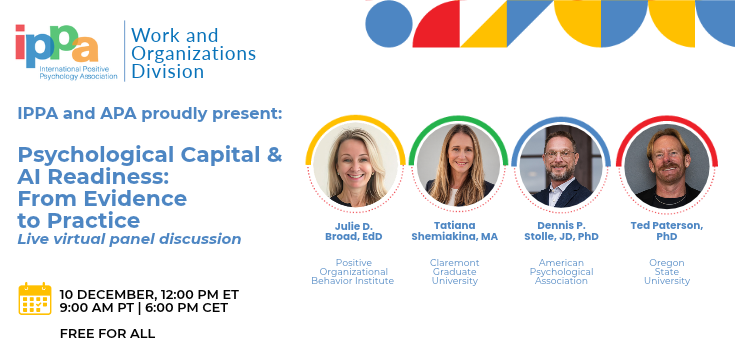
IPPA and APA proudly present: Psychological Capital and AI Readiness: From Evidence to Practice — Live panel discussion
Speaker: Dennis Stolle, Tatiana Shemiakina, Ted Paterson, Julie Broad
Date & Times: December 10 | Thursday, December 10, 2026 | 12:00–1:00 p.m. ET / 18:00–19:00 CET
Member Price: $0
Non Member Price: $0
Access: Open to all
Event Type: live
As AI reshapes work, organizations are investing heavily in technical skills, often overlooking the psychological resources that shape how people adapt. APA’s 2026 Work in America™ survey offers new evidence on this: workers with higher psychological capital (PsyCap) were more likely to use AI, perceive new opportunities, and feel secure about their future, and less likely to fear their roles becoming obsolete.
Because PsyCap is state-like and developable, these findings raise important questions for research and practice. How should we interpret these associations? How can PsyCap be assessed responsibly at the individual and team level? Which interventions show promise, and what role do workplace conditions and leadership play?
Join IPPA’s Work and Organizations Division and APA for an interactive panel bringing together survey research, PsyCap measurement, intervention design, and organizational practice. Participants will gain evidence-based perspectives on supporting people through AI-driven change, with the opportunity to put their own questions to the panel.
Read more about this fascinating topic at this blog post by Mark Chan, PhD, and Dennis P. Stolle, JD, PhD.
Speaker bios:
Ted A. Paterson, Ph.D. is a Professor of Management at Oregon State University, Director of the Center for Family Enterprise, and the L. W. “Bill” Lane Professor in Family Business Management. He currently serves as Co-Editor for the Journal of Business Research. He received his Ph.D. from the University of Nebraska. His research interests center on positive organizational behavior, where his work on psychological capital has explored its role in entrepreneurship and thriving at work. His research has been published in Journal of Applied Psychology, Personnel Psychology, Journal of Management, and other outlets.
Dennis P. Stolle, JD, PhD, is Executive Lead Psychologist for Applied Psychology at the American Psychological Association. A social and personality psychologist and attorney, he translates psychological science into practical insights about human flourishing and performance, with particular attention to how people interact within complex systems. His work includes APA’s 2026 Work in America survey, which examined how psychological capital relates to workers’ well-being, job satisfaction, and experiences with change in the workplace.
Julie D. Broad, Ed.D. is the Founder and President of the Positive Organizational Behavior Institute (POBI) where she works with global scholars on the research and application of evidence-based approaches to measuring, developing, and sustaining psychological capital within organizations. Julie received her doctorate from The George Washington University. Her research interests center on the development of group and team, or collective, psychological capital, as well as the development of organizational well-being and performance maps for proactive and targeted intervention.
Tatiana Shemiakina is a doctoral researcher in Positive Organizational Psychology at Claremont Graduate University, Director of Operations at the Claremont Flourishing Center, and a finalist in IPPA’s 2025 Positive Organizational Intervention Challenge (POIC). As a researcher and practitioner, she specializes in designing, implementing, and evaluating positive psychology interventions, with a particular focus on developing Psychological Capital (PsyCap). Her interests include innovative intervention design, gamification, experiential learning, and the integration of artificial intelligence into positive psychology interventions. She is passionate about bridging science and practice to create meaningful, engaging, and scalable solutions for individuals, teams, and organizations.