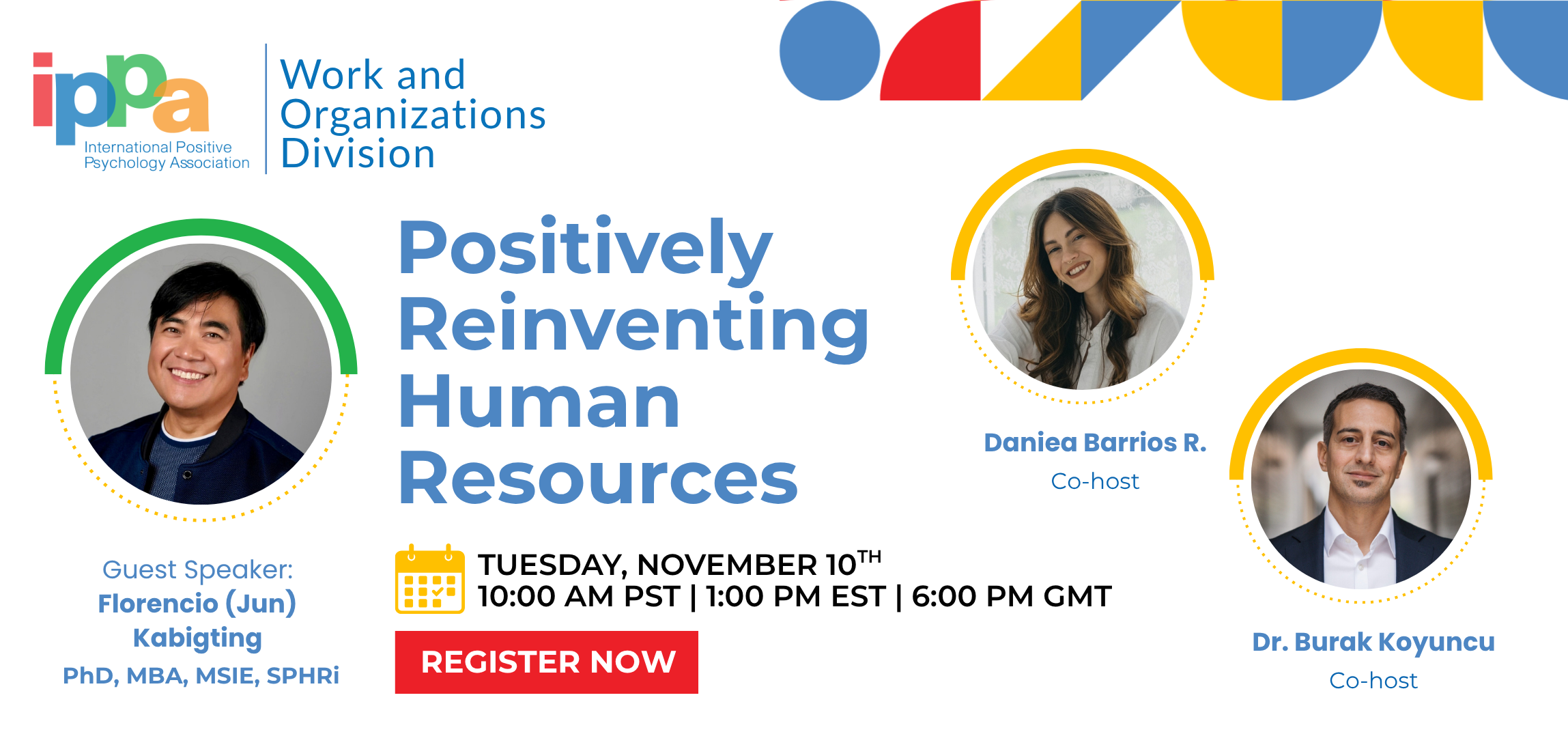
Work & Org Presents: PWC- Reinventing Human Resources
Speaker: Florencio "Jun" Kabigting, PhD, MBA, MS, SPHRi
Date & Times: November 10 | 10:00 AM PST / 1:00 PM EST / 6:00 PM GMT
Member Price: $0
Non Member Price: $25
Access: Open to all
Event Type: live
Human resource management (HRM) increasingly faces the dual challenge of contributing to organizational effectiveness while supporting employee well-being, dignity, development, and fair treatment. Strategic HRM research has traditionally examined how HR systems contribute to performance and organizational value creation (Ulrich & Brockbank, 2011). At the same time, an expanding body of research examines how HRM shapes employee health, resilience, engagement, meaningfulness, fairness perceptions, and the quality of employment relationships (Cooper et al., 2019; Hauff et al., 2020; Hauret et al., 2022; Xiao et al., 2022; Tabassum et al., 2019). These parallel developments raise an important theoretical and practical challenge: how can HR systems be designed to advance sustainable organizational effectiveness without treating employee well-being, dignity, and development as secondary or merely as a means to an end?
In this conversation, the Speaker advances “Positive HRM” as a proposed system-level HRM architecture that addresses this challenge. Positive HRM refers to the intentional design and implementation of integrated HR practices that seek to develop employees’ capabilities, support their motivation and participation, foster fair and reciprocal employment relationships, build and protect valued resources, and contribute to employee flourishing alongside sustainable organizational effectiveness. Positive HRM’s explanatory mechanisms are anchored on three widely-recognized Organizational Behavior theories: Ability-Motivation-Opportunity Theory (AMO, Bos-Nehles et al., 2023), Social Exchange Theory (SET; Blau, 1964), and Conservation of Resources Theory (COR; Hobfoll, 1989). Although AMO, SET, and COR explain potential mechanisms, they do not independently establish whether an HRM system should be characterized as “positive.” As such, Positive HRM’s “positive” characterization principally derives from the complementary principles as normative and developmental boundaries. That is, positive psychology contributes insight into strengths, well-being, and flourishing; humanistic perspectives contribute dignity and development criteria; ethical HRM contributes organizational justice and legitimacy criteria; and transformational HRM perspectives contribute constructive-change and capability-building criteria.
Florencio (Jun) Kabigting, PhD, MBA, MSIE, SPHRi
Jun is a senior HR leader and positive organizational psychology scholar-practitioner who bridges rigorous research with real-world HR leadership to build strengths-first workplaces. He has deep combined industry, consulting, and academic experience across Asia and the US, specializing in positive organizational psychology and evidence-based HRM. Jun also brings extensive graduate-level teaching experience in HRM, organizational behavior, Positive HRM, and evaluation science. He wants to help transform the world of work so people and organizations can achieve breakthroughs in performance, profitability, efficiency, and well-being.
This event has passed.